Why Your P&L Is More Than Just a Statement
Whether you call it a P&L, Profit and Loss Statement, or Income Statement, your P&L can be one of your sharpest tools in carving out your future. In the most basic terms, your P&L is a summary of revenue in and expenses out to show your profit or loss over a specific period of time. It can be run on either a Cash or Accrual basis, and it matters which one you are using:
Cash Basis: Records transactions only when cash actually changes hands. While simple, it often fails to provide the full picture of ongoing financial health.
Accrual Basis: Records revenue when earned and expenses when incurred. This method offers the most accurate view of performance by matching income with the efforts required to generate it.
For instance, if you complete a project in July but receive payment in August, the Accrual method recognizes that revenue in July. To truly understand your company's real-time performance, viewing reports on an Accrual basis is essential.
The Three Pillars of an Accurate P&L
Your P&L is a window into your business’s future, but only if it’s framed correctly. Financial management shouldn’t be a DIY project. A mentor once shared with me: "If you are more concerned with being right than getting better, you will never get better." While I am not afraid to pick up a hammer and nails for home small repairs, I also know when to call a professional to ensure a window doesn’t leak or stick. The same logic applies to your books. To ensure your P&L serves you effectively, focus on these three pillars:
Proper Setup: This is your foundation. Don’t force your transactions into generic software categories that don’t fit your business model. Accurate mapping of accounts—ensuring office supplies aren’t accidentally coded as revenue—is critical. A skilled bookkeeper who understands your industry can set up accounts subaccounts that allow you to toggle between granular root-cause analysis and a high-level strategic overview in seconds.
Accurate Data: Keep the date accurate and up to date, maintain strict discipline by keeping personal purchases out of business finances. It doesn’t matter what that online influencer you saw said, your daily McDonald’s lunch is likely not a legitimate tax write-off. Mixing expenses obscures your true profitability and complicates tax compliance.
Regular Review: Data is only useful if it is reviewed and understood. Consistent analysis helps you comprehend the story your numbers are telling, allowing for proactive adjustments. Having someone that can review this with you will help to ensure you are getting the most out of the report and not missing trends or anomalies that could come back to bite you if overlooked.
Once your software is established, keep your data current and within defined guardrails. Before adding new accounts, ask yourself: "Will this help me make better decisions?" A "Miscellaneous" account can be useful for rare items, but it should never compromise the overall clarity of your reporting. Finally, protect the integrity of your reporting. While tax professionals or loan officers may request specific formats to suit their needs, remember that this P&L is first and foremost a tool for your business. If your mapping is thorough, they can extract the data they need without you having to dismantle a system that works for your daily operations. Your reporting should follow a standard framework for readability, but it must remain optimized for your strategic growth.
Using Your P&L to Make Business Decisions
Let’s look at a simple example of how a P&L can inform your strategy. First, the 30,000-foot view:
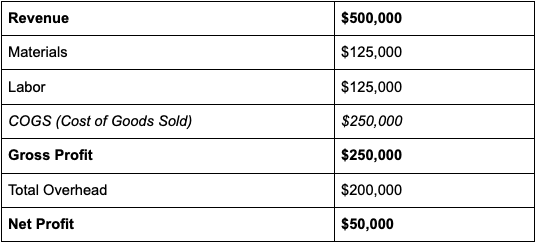
Image of a sample P&L or Income Statement
At first glance, a 10% Net Profit seems acceptable. However, look at the clarity provided when we segment the data by service lines:
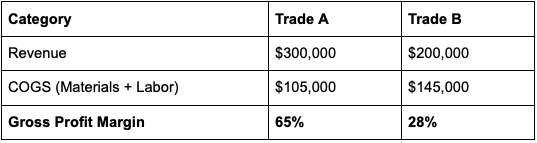
Breakout of different revenue sources preformance
Now you have actionable data. Trade B is underperforming and diluting the success of Trade A. With this insight, you can decide whether to adjust pricing for Trade B or discontinue that line entirely to boost overall profitability. To carry this just a bit further, if Trade B was responsible for just a third of the overhead costs, dropping the service would actually increase their net profit by over $11,000 while taking on less work and risk. Without this breakdown, Trade B’s inefficiencies would remain hidden behind Trade A’s strong results.
Beyond segmenting trades, a well-managed P&L allows you to spot trends early, ensure pricing keeps pace with rising material costs, prepare for seasonal fluctuations and even help identify fraud, theft of supplies and embezzlement. Whether you are facing an expiring line of credit or need to replace equipment, an accurate P&L ensures you are making those moves with confidence rather than guesswork.
A final thought
Let’s wrap this with this quick thought. Unfortunately there are a lot of individuals out there calling themselves bookkeepers with unsound foundations, mostly at no fault of their own. Usually they were thrown into the role out of necessity or they bought a training platform from a “snake oil salesman” promising that they can charge top dollar rates within a week but only providing them the bare minimum essentials overview and a high five at the end without providing the fundamental accounting/bookkeeping principles that help them understand the checks and balances that need to be in place to maintain the integrity of their finance system. Your books are your business's financial foundation. They should be given the attention and respect they deserve. Don’t let just anyone do them. Whoever you have doing your books should at the least know and understand the basic principles of bookkeeping, understand your industry well enough to customize your books to your business, and have a basic knowledge of standard trends within your industry to help spot anomalies.
What to discuss this topic deeper? Feel free to reach out to us, we love talking to small businesses to see how we can help them better take control of their company!
